The data, briefly
Voicemail-completion rates for residential business calls have been trending down for the better part of two decades. Estimates we've seen in industry reporting and trade-forum threads put the current rate well under 20% for residential service calls — and several shop owners we've talked to put it lower. Whatever the precise number, every shop owner reading this already knows the trend: customers don't leave voicemails. They hang up and call the next number Google shows them.
This isn't a generational thing. It's not just younger customers. The same homeowners who used to dictate a 90-second message about the leak under their kitchen sink in 2010 will now end the call after one ring and tap the next plumber.
Why this happened
Three things changed at the same time, and the combination is what killed voicemail.
1. The next option is one tap away. When you Googled 'plumber near me' in 2008, you got a list and you committed to one. In 2026, you get a list and you call all of them, in order, until someone picks up. The cognitive cost of trying the next number is now zero.
2. Mobile changed how voicemail works. On a landline, you knew the message would land in someone's hands. On a mobile phone, the message lands in a transcribed text view that the recipient might or might not look at for hours. Customers correctly intuited that calling the next shop was higher-bandwidth than leaving a message.
3. We trained ourselves to expect chat. A whole generation now expects 'send a message' to mean 'get a real-time response within minutes.' Voicemail violates that expectation by design.
They don't leave voicemails. They hang up and call the next number Google shows them.
What this means for trade shops specifically
If you're a plumber, HVAC tech, electrician, roofer, or landscaper, the math is brutal. Rough estimates from public industry reporting and trade-forum threads suggest a third to half of inbound calls go unanswered during work hours, that the large majority of those callers don't leave a voicemail, and that most of them call a competitor next. Net it out and you're losing meaningful inbound demand silently.
Silently is the worst part. A missed call that converts to a competitor doesn't show up in any of your metrics. There's no log entry, no Google Analytics event, no CRM record. It's revenue that just doesn't exist for you, and you'd never know unless you looked at your missed-call list and the call duration column shows :00.
What shops are doing about it
Three approaches dominate, ranked from cheapest-and-worst to most-effective.
Approach 1: Voicemail-to-text + faster callback. Some shops set up systems where voicemails get transcribed and texted to the owner immediately. Faster than checking voicemail manually, but still depends on the customer leaving a message — and as we just established, most don't.
Approach 2: Hire a real-human answering service. Smith.ai, Ruby Receptionists, AnswerConnect, AnswerForce. Real humans answer your phone when you can't. This works, with two caveats: cost (per-call or per-minute, often $300–$2,000+/month) and trade fit (the human picking up doesn't necessarily know what a P-trap is or whether 'half my house is out' is a tripped breaker or a real outage).
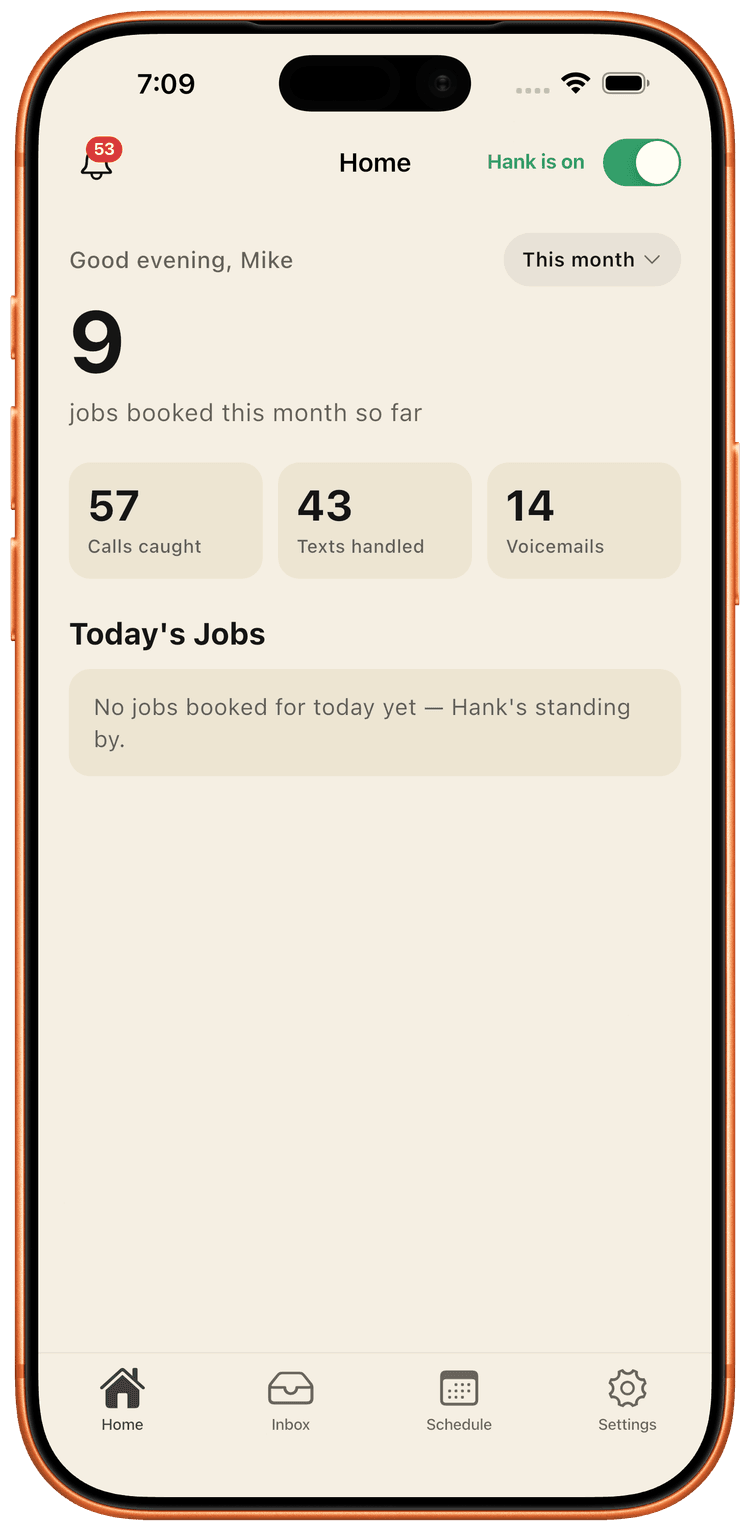
Approach 3: Use an AI answering service built for trades. Newer category as of 2026. The advantages are flat-rate pricing (no per-call surprises during heat waves or storm surges), trade-specific qualification (it knows the difference between a service call and a commercial estimate), and 24/7 coverage without surcharges. The trade-off is that AI doesn't yet handle genuinely unusual emotional calls as gracefully as a human would.
The real question: what's the cost of doing nothing?
Most shop owners we talk to think the cost of missed calls is roughly the value of one job times the number of misses. That undercounts in two ways.
First, every missed call that converts to a competitor isn't just one lost job — it's also lost downstream: the repeat work, the referrals to neighbors, the maintenance plan they would have signed up for. The lifetime value of a missed customer is typically 3–5× the immediate job value.
Second, missed calls are concentrated in your highest-leverage moments. A missed call on a Tuesday afternoon costs you a service call. A missed call during a heat wave when you're already maxed out costs you a customer who specifically remembers that they tried you and you didn't answer. They never call back.
What we recommend
If you're a solo or small trade shop and the voicemail-conversion problem is biting you, the order of operations we'd suggest:
Step 1. Look at your call log for the last 30 days. Count how many inbound calls had a duration of 0:00 (rang, didn't connect or didn't get answered). That's your missed-call baseline. Most shops are surprised — the number is usually higher than the felt experience.
Step 2. Of those misses, estimate how many would have converted if a real person had answered. A reasonable starting estimate: 50–60% for plumbing emergencies, 40–55% for HVAC service calls, 30–45% for roofing estimates (more shopping behavior), 50–60% for landscaping signups.
Step 3. Multiply by your average ticket value. That's the monthly cost of doing nothing.
Step 4. Compare against the cost of the three approaches above. For most shops with consistent inbound volume, an AI answering service or a flat-rate human service costs roughly one missed job's worth of revenue per month and pays for itself instantly.
Stop missing the calls.
Free for 30 days, then $149/mo. Set up yourself in about 5 minutes — we’ll walk you through it if you want.
Get hank on your line