Meet the shop
Let's say you run a two-truck plumbing operation. It's you and one other guy. You both turn wrenches all day — there's no front office, no receptionist, no kid answering phones in the back. The phone is your cell, and your buddy's cell, and that's the whole system.
On a normal day the two of you run maybe eight to ten service calls between you: water heaters, clogged mains, leaky shutoffs, the occasional remodel rough-in. Your average ticket runs about $340. Some jobs are a $150 snake job, some are a $1,800 water heater swap, but $340 is where it averages out.
Business is fine. You're busy. That's exactly the problem.
Count the calls you never answered
Here's the thing about being busy: when you're under a sink with a basin wrench in one hand and a flashlight in your teeth, you are not answering the phone. When your partner's in a crawlspace, he's not either. When you're both driving to the next job, you might catch it or you might not.
So count honestly. On a typical day, how many calls ring out between the two of you? Not the ones you sent to voicemail on purpose — the ones you physically couldn't get to. For a busy two-man shop it's usually three to five a day. Let's call it four.
Four missed calls a day, six working days a week, is 24 missed calls a week. Round down for slow days and call it 20 a week. That's 20 chances a week that someone with a plumbing problem dialed your number and got nothing.
A hundred and six thousand dollars. On a two-man shop. From calls you never even knew you missed.
Not every missed call is a lost job — be fair about it
Now, not all 20 of those are real money. Some are spam. Some are a supplier calling back. Some are the same customer calling twice. Some are tire-kickers who were never going to book.
So let's be conservative and say only half of your missed calls are real, would-have-booked customers. That's 10 genuine missed jobs a week walking to the next plumber in the search results.
And let's say of those 10, you'd realistically have closed 60% if you'd answered live — plumbing emergencies close high because the customer needs it fixed now. That's six booked jobs a week you're handing to someone else.
Put the dollars on it
Six booked jobs a week, at your $340 average, is $2,040 a week. Over a month (4.33 weeks) that's about $8,830. Over a year, you're looking at roughly $106,000 in revenue that rang your phone and then booked with somebody else.
Read that again. A hundred and six thousand dollars. On a two-man shop. From calls you never even knew you missed, because a missed call leaves no trace except a 0:00 in your call log.
And that's the conservative version. We threw out half the calls as junk and assumed a 60% close rate. If your real numbers are better than that — and for emergency plumbing they often are — the figure climbs higher.
The part the spreadsheet misses
That $106,000 is just the immediate jobs. It doesn't count what happens after.
When a customer calls you, gets nothing, and books with another plumber who does a good job, that plumber didn't just win one ticket. He won the next clog, the next water heater, the maintenance call, and the time the customer tells their neighbor 'I've got a guy.' A first-time residential plumbing customer who sticks around is worth several times that first ticket over a few years.
So the real annual cost of a busy two-man shop's missed calls isn't $106,000. It's that number plus the slow bleed of every customer relationship that got started by your competitor instead of you. The jobs you can see are the tip of it.
What it would take to fix
Here's the math that makes the decision easy. You're losing somewhere around $8,800 a month in bookable jobs. What would it cost to simply answer the phone?
You could hire someone — but a part-time person to sit by a phone runs $1,500 to $3,000 a month, plus the headache of managing them, plus they're not there evenings or weekends when a third of plumbing emergencies happen. You could lean on your spouse, but most shops that try that quietly end the arrangement within a year and a half because it wears on the relationship.
Or you could have the line answered for a flat fee in the low hundreds a month. Against $8,800 in jobs walking out the door, almost any version of 'someone answers the phone' pays for itself the first week. The only option that costs you real money is the one you're running now: letting it ring.
Run your own numbers
Don't take our two-man shop as gospel — plug in your own. Your missed-call count, your average ticket, your close rate. The shape of the answer almost never changes: for a busy small shop, missed calls are the single biggest leak in the business, and it's a leak nobody put on the books.
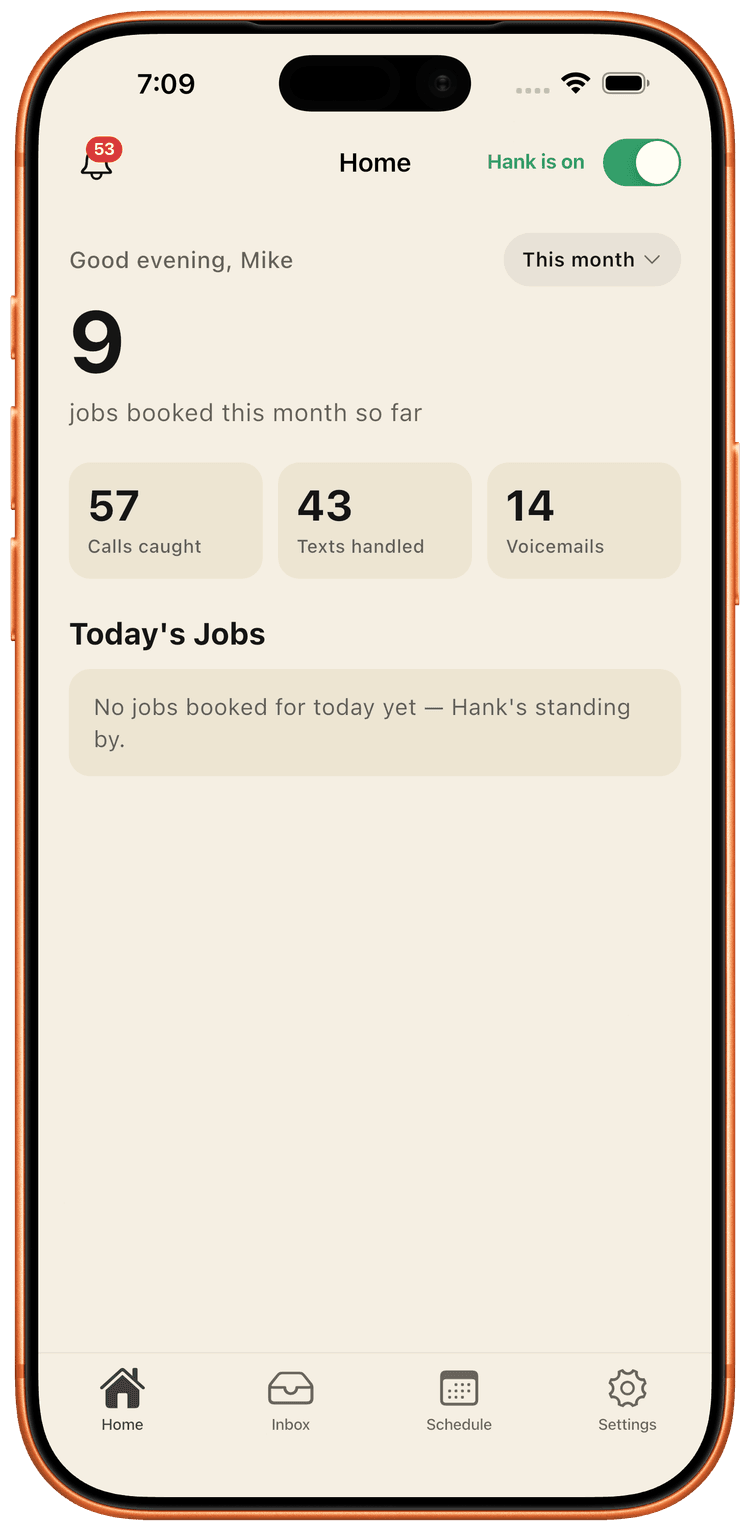
If you want the line answered without hiring anyone, that's what Hank does. It picks up when you and your partner can't, talks like your shop, qualifies the job, and texts you the details so you can keep working with both hands. Flat monthly fee, and you can try it free for a month and watch what lands in your text messages.
Stop missing the calls.
Free for 30 days, then $149/mo. Set up yourself in about 5 minutes — we’ll walk you through it if you want.
Get hank on your line