A few rings, then they move on
Picture the customer on the other end. Their basement is filling with water, or the AC quit on the hottest day of the year, or there's a brown spot spreading across the ceiling. They are not relaxed. They pulled up a list of shops on their phone and they're working down it.
They dial you. It rings. One ring, two rings, three — and their thumb is already moving. They don't wait for the beep. They don't compose a message. They hang up and tap the next number on the list, because the next number might pick up, and picking up is the only thing they actually care about right now.
That's the whole behavior. It isn't rudeness and it isn't a generational quirk. It's a person with an urgent problem doing the rational thing: trying the next door instead of knocking twice on yours.
Voicemail asks the customer to do your job
Think about what leaving a voicemail actually requires. The customer has to stop dialing, switch mental gears, explain their problem out loud to a machine, recite their phone number clearly, and then — this is the part that kills it — wait, with no idea whether you'll call back in five minutes or five hours or at all.
Meanwhile the next shop on their list is one tap away and might answer live. From where they're standing, leaving a message is the slow lane and calling the next number is the fast lane. Every time, they take the fast lane.
So the voicemail box you set up to 'catch' calls catches almost nothing. The customers who needed you most are exactly the ones who won't leave a message, because they're the ones in a hurry.
The hang-up isn't rejection — it's a head start for your competitor.
A hang-up is invisible, and that makes it worse
Here's the cruel part. When a customer hangs up and calls your competitor, nothing happens on your end. No message. No notification. No record except a missed-call entry with a duration of 0:00 that you'll never scroll back far enough to notice.
You don't feel the loss because there's nothing to feel. The job just quietly becomes someone else's job. You find out about it — if you ever find out — months later when you see your competitor's truck parked in front of a house in your neighborhood, doing work that would have been yours if you'd been the one who picked up.
Compare that to a customer who shows up, gets a quote, and goes with someone else. That one stings, but at least you know it happened and you can learn from it. The hang-up gives you nothing to learn from. It's pure, silent leakage.
What one hang-up actually costs
Let's put a number on it, because 'you're losing calls' is easy to wave off and a dollar figure isn't.
Say your average job is worth $340. A customer hangs up, calls the next shop, and books with them. That's $340 gone — but the real bill is bigger. If they liked the other shop, you also lost the next service call they'll make, the time they'll recommend a neighbor, and the maintenance work down the road. For a lot of trades that turns one $340 hang-up into well over $1,000 of lifetime value handed to a competitor.
Now multiply by how often it happens. If five calls a week ring out and three of those would have been real jobs, you're not losing one hang-up — you're losing somewhere north of a dozen a month, every month, without a single line item to show for it.
You can't out-discipline a ringing phone
Most owners' first instinct is to try harder. Keep the phone closer. Check it between jobs. Call people back faster. And for a while that helps a little.
But you can't answer a phone while you're shoulder-deep under a sink, on a roof in the wind, or driving with both hands on the wheel. The calls that ring out aren't ringing out because you're lazy. They're ringing out because you're working. That's the whole trap: the busier you are doing the job, the more of the next job you miss.
The fix isn't more willpower. It's making sure the phone gets answered when your hands are full — so the customer hears a voice instead of a beep, and your name stays at the top of their list instead of getting crossed off.
The bottom line
The hang-up isn't the customer rejecting you. It's the customer not having a reason to wait. Give them a reason — a real answer, a quick 'we can get someone out to you' — and the same person who would've hung up after a few rings becomes a booked job instead.
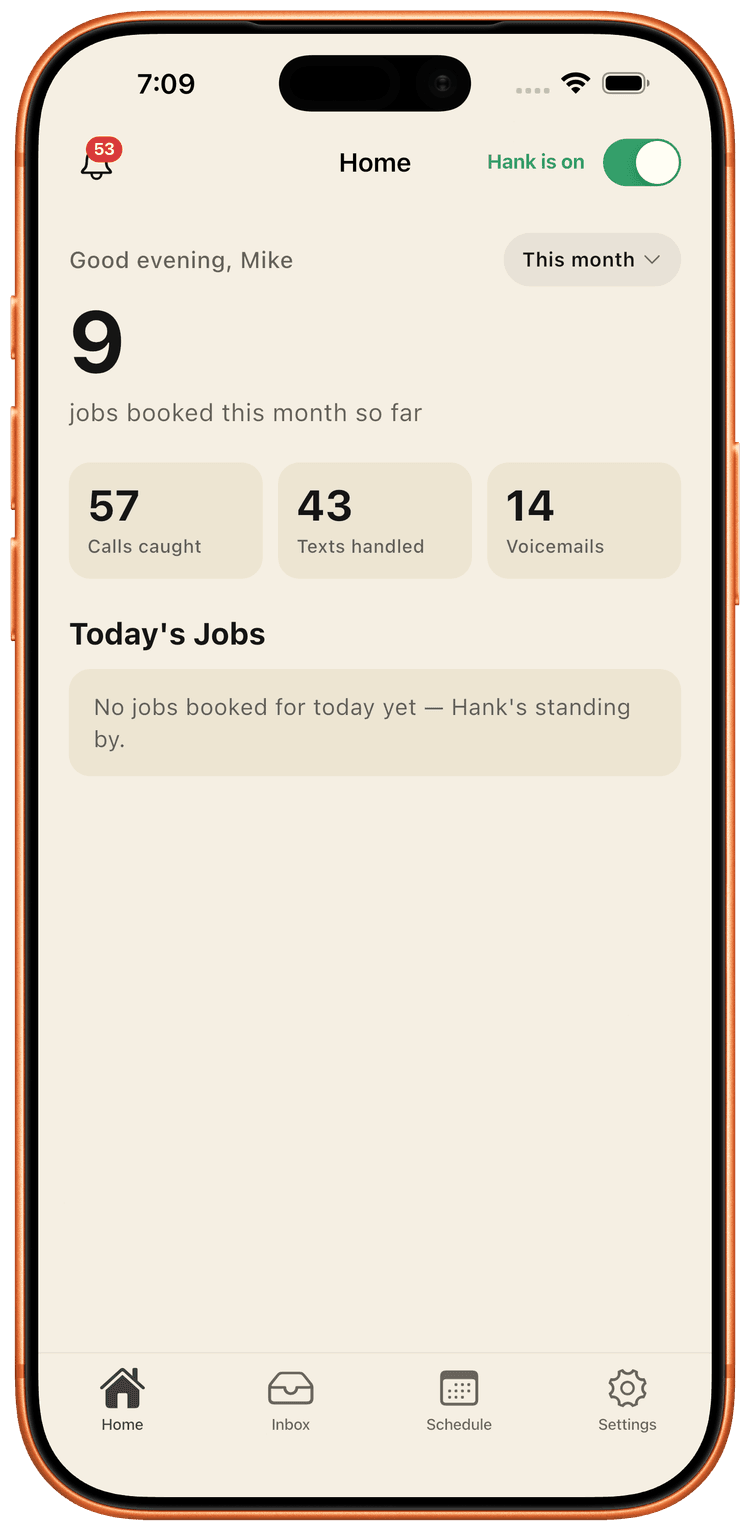
That's the entire game. Whoever picks up gets the work. If you can't always be the one to pick up, the next best thing is having someone — or something — answer in your name so the call never has to ring out in the first place. That's the problem we built Hank to solve: it answers your line when you can't, talks like your shop, and books the job so the hang-up never happens.
Stop missing the calls.
Free for 30 days, then $149/mo. Set up yourself in about 5 minutes — we’ll walk you through it if you want.
Get hank on your line